
Skip to content
Mead & Hunt logo
  • Markets
    • Aviation
    • Cultural Resources
    • Education
    • Federal
    • Food & Beverage
    • Justice
    • Renewable Energy
    • State & Local
    • Transportation
    • Water
  • Services
    • Architecture & Interiors
    • Commissioning
    • Construction Services
    • Engineering
    • Environmental
    • Fabrication & Custom Manufacturing
    • Planning
    • Sustainability & Resilience
    • Technology & Security
  • Portfolio
  • News
  • About
    • Purpose & Values
    • Meet Our Team
    • Inclusion & Belonging
    • Corporate Responsibility
    • Locations
    • Scholarship Opportunities
    • Our History
    • Mead & Hunt Foundation
  • Careers
  • Markets
    • Aviation
    • Cultural Resources
    • Education
    • Federal
    • Food & Beverage
    • Justice
    • Renewable Energy
    • State & Local
    • Transportation
    • Water
  • Services
    • Architecture & Interiors
    • Commissioning
    • Construction Services
    • Engineering
    • Environmental
    • Fabrication & Custom Manufacturing
    • Planning
    • Sustainability & Resilience
    • Technology & Security
  • Portfolio
  • News
  • About
    • Purpose & Values
    • Meet Our Team
    • Inclusion & Belonging
    • Corporate Responsibility
    • Locations
    • Scholarship Opportunities
    • Our History
    • Mead & Hunt Foundation
  • Careers
Mead & Hunt logo
  • Markets
    • Aviation
    • Cultural Resources
    • Education
    • Federal
    • Food & Beverage
    • Justice
    • Renewable Energy
    • State & Local
    • Transportation
    • Water
  • Services
    • Architecture & Interiors
    • Commissioning
    • Construction Services
    • Engineering
    • Environmental
    • Fabrication & Custom Manufacturing
    • Planning
    • Sustainability & Resilience
    • Technology & Security
  • Portfolio
  • News
  • About
    • Purpose & Values
    • Meet Our Team
    • Inclusion & Belonging
    • Corporate Responsibility
    • Locations
    • Scholarship Opportunities
    • Our History
    • Mead & Hunt Foundation
  • Careers
  • Markets
    • Aviation
    • Cultural Resources
    • Education
    • Federal
    • Food & Beverage
    • Justice
    • Renewable Energy
    • State & Local
    • Transportation
    • Water
  • Services
    • Architecture & Interiors
    • Commissioning
    • Construction Services
    • Engineering
    • Environmental
    • Fabrication & Custom Manufacturing
    • Planning
    • Sustainability & Resilience
    • Technology & Security
  • Portfolio
  • News
  • About
    • Purpose & Values
    • Meet Our Team
    • Inclusion & Belonging
    • Corporate Responsibility
    • Locations
    • Scholarship Opportunities
    • Our History
    • Mead & Hunt Foundation
  • Careers

Is Forward Osmosis Your Wastewater Concentration Solution?

  • January 31, 2023
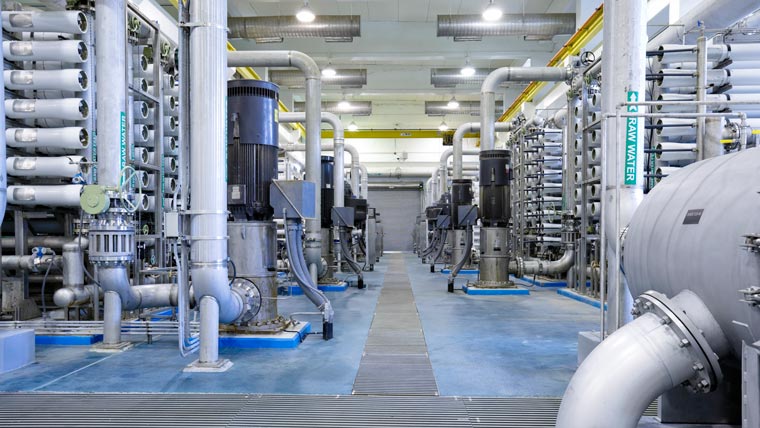
interior of wastewater treatment plant

There is some truth to the old environmental engineering adage, “the solution to your pollution is dilution.” But as water and energy become more valuable, old ideas are being challenged. For industrial clients, this means a greater emphasis on recovering water. At the same time, energy generated from non-fossil fuel sources is becoming more desirable. This has lowered the threshold at which wastewater shifts from a headache to a resource. This shift will incentivize developing technologies that focus on harnessing this resource rather than diluting it. One such technology is Forward Osmosis (FO).

Forward Osmosis vs. Reverse Osmosis

Reverse Osmosis (RO) is a well-known method of removing salt from water. Pressure is applied to the side of the membrane with a high salt concentration. This creates the osmotic potential to push water through the membrane, leaving the salt behind. FO works in the opposite direction, pulling water through the membrane by placing an even saltier (100,000-250,000 ppm) draw solution on the other side. This is the natural, low-energy osmotic process with flow across the membrane driven by salt concentration differential, not pressure. The incoming draw solution is more concentrated, resulting in a diluted draw solution on the other side. The diluted draw solution must be regenerated by removing the water or solute, which is where modern, forward osmosis systems shine.
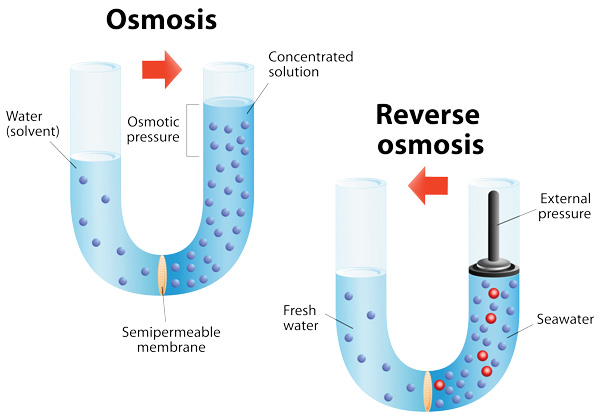
diagram showing reverse and forward osmosis

One method of regenerating the draw solution is using a high-pressure RO to remove the salt from the draw solution. This may seem counter-intuitive because the purpose of an FO system is an alternative to RO for removing salt from water. However, the draw solution can be made using only divalent salts such as MgCl, which RO membranes easily remove. Also, the diluted draw solution is a mixture of pure water and the selected salt, without other impurities to clog the membrane. Other methods include unique materials that come out of the solution under specific heat and pressure conditions. Depending on the client’s goals and facility characteristics, these proprietary processes can offer benefits over RO regeneration.

What are the benefits of FO?

Regardless of how the diluted draw solution regenerates, FO systems have some significant advantages over conventional RO when managing wastewater. Most importantly, FO systems routinely recover over 90% of wastewater, compared with 75-80% for an RO system. This goes a long toward helping clients with sustainability mandates or minimum liquid discharge (MLD) regulations. It also means the concentrated reject is twice or greater in concentration than an RO system, making it more valuable for other uses. For instance, twice as much biological oxygen demand (BOD) means twice as much energy per volume for an anaerobic digester.

FO systems can also handle stronger and more complex wastewater. The effectiveness of RO systems decreases drastically as the concentration of contaminants in the wastewater increases. For this reason, most RO systems have several pre-treatment steps upstream, such as micro-, ultra-, or even nanofiltration, to remove larger particles. But FO systems are designed to remove water from wastewater, allowing particles to continue toward the reject stream instead of blocking membrane pores. This also results in less frequent backwashing cleanings. When an FO membrane does need to be cleaned, it is a simpler process due to the lower operating pressure. Particles are not embedded into the membrane under pressure, making them easier to remove with the cleaning solution. This further increases the longevity of the FO membrane because those embedded particles in an RO membrane lead to irreversible performance loss (or permeability).

FO is not for everyone

For all of their advantages, FO systems do have some drawbacks. They generally use more energy per unit of wastewater treated and can have a higher capital cost, depending on the type of draw regeneration. The best situation for an FO system is typically managing a wastewater stream that is strong and complex. An FO system can recover water for reuse and generate a stronger wastewater that changes waste into a valuable product for another user. No single technology is appropriate for every situation. A skilled water or wastewater engineer can help you determine which solution is right for you, and FO is a welcome addition to the toolkit.


headshot of Ross Varin

Ross Varin

As an environmental engineer, Ross is skilled in finding tailored solutions to client water/wastewater challenges across various sectors, from municipal to food & beverage to aviation. His project experience includes municipal wastewater treatment plants, biosolids management, and industrial pretreatment systems, among others. When not at work, you can find Ross mountain biking in the Cascades or bird watching in Puget Sound.

Linkedin Envelope Readme
PrevPrevious
NextNext

Most Popular

Mead & Hunt Names Kristin Moore as CFO
July 10, 2026
America’s 250th: A Tavern, a Revolution, and 100,000 Artifacts
July 1, 2026
New Report Explores Opportunities and Challenges of AI in Airport Security
June 24, 2026
Evaluating Ohio’s Postwar Neighborhoods: A New Framework for Preservation and Compliance
June 22, 2026

Main Menu

  • Home
  • Markets
  • Services
  • Portfolio
  • News
  • About
  • Careers
  • Home
  • Markets
  • Services
  • Portfolio
  • News
  • About
  • Careers

Useful Links

  • Ebids
  • Corporate Responsibility
  • Equipment & Parts
  • GSA Schedules Program
  • Government Contract Vehicles
  • Policy for Third-Party Recruiters
  • Transparency in Coverage
  • Ebids
  • Corporate Responsibility
  • Equipment & Parts
  • GSA Schedules Program
  • Government Contract Vehicles
  • Policy for Third-Party Recruiters
  • Transparency in Coverage

Get in touch

  • Apply Today
  • Contact Us
  • Locations
  • Title VI
  • Apply Today
  • Contact Us
  • Locations
  • Title VI

Connect with us

Linkedin Facebook Instagram Vimeo

© 2026 Mead & Hunt, Inc. All rights reserved.

Privacy Settings | Privacy & CCPA Policy | Do Not Sell | Site Map