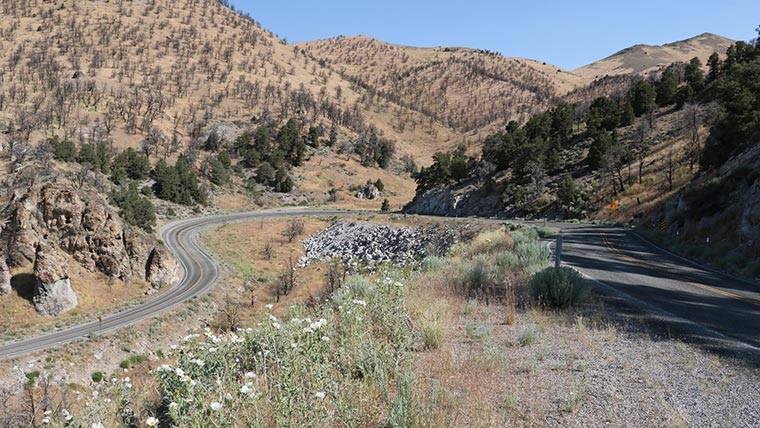
Evaluating a historic road segment for National Register of Historic Places (NRHP) eligibility can require a lot of effort. Researching the trends and themes to understand the history and significance of a road compared to other similar roads is a daunting task and can result in an inconsistent application of the National Register Criteria for Evaluation. This is especially true for assessing integrity, or the ability of a road to convey its historic significance. To aid in this process, the National Park Service’s National Register Multiple Property Documentation Form (MPDF) provides an approach to place a property with the appropriate historic context and understand its significance and integrity. This helps to provide greater consistency in evaluating similar properties over time.
What is an MPDF?
A Multiple Property Documentation Form, or MPDF, is part of an accepted approach for documenting and evaluating similar or related properties with a common history, use, and/or physical features. The MPDF streamlines the method of organizing information collected in surveys and research for nominating properties to the National Register as well as planning purposes. The form facilitates the evaluation of individual properties by comparing them with resources that share similar physical characteristics and historical associations. An MPDF is a very useful tool for identifying and contextualizing highways and associated properties to determine if they possess historical importance within multiple historic contexts and integrity thresholds. The use of an MPDF can lessen the amount of research needed to begin projects and streamline the process to nominate a property for listing in the National Register. In this way, creating an MPDF represents an investment in the future, because these forms guide future research and analysis that can be undertaken by numerous historians, resulting in time savings and predictability when the guidance is adopted and followed.
What can an MPDF do for your project?
An MPDF will proactively guide research on historic properties and establish a transparent approach to understand properties that may take a lot of time to research. Roads in particular have complicated histories and require clear and consistent approaches for determining National Register eligibility. Departments of Transportation (DOTs) nationwide can attest to this fact.
MPDFs applied: The Lincoln and Victory Highways Case Study
We saw the benefits of using MPDFs firsthand in our work for the Nevada Department of Transportation (NDOT) when MPDFs were used for the Lincoln Highway and Victory Highway. NDOT needed a comprehensive approach to evaluating segments of these two early named transcontinental roads across the entire state. The completed MPDFs enhance the understanding of the history of these highways, and inform planning and early project development statewide as part of NDOT’s regulatory responsibilities under Section 106 of the National Historic Preservation Act and other environmental regulations.
Our team helped identify and evaluate a range of transportation-related properties ranging from the roadbed itself to road-related properties along the highways such as automobile service stations, gas stations, and motels, among others. The MPDFs provide a statewide historic context and serve to guide property-specific research, describe character-defining features of associated property types, and outline evaluation criteria to establish a grounded approach for completing National Register evaluations. We provided NDOT with the MPDFs, one National Register nomination, and several determinations of National Register eligibility, and the State Historic Preservation Office (SHPO) agreed with the findings.
The MPDF provides an accepted National Park Service (NPS) document that can be used by not only NDOT, but any local, state, or federal agency or member of the public wishing to understand the historic importance of the roadbed, or the buildings and structures associated with the Lincoln or Victory highways in Nevada. In this way, the MPDFs pre-emptively identify historic properties related to these two highways and guide historians who need to evaluate properties associated with the MPDFs. Public agencies will use the MPDFs to streamline Section 106 reviews for projects affecting either of the highways.
NDOT provides the MPDFs on its webpage for consultants and other agencies. Ultimately, the MPDFs provide a better understanding of the Lincoln and Victory highways and how they fit within Nevada’s transportation history of road construction.
Key takeaways
The histories and engineering of highways are rarely simple and straightforward. Using proven methods such as an MPDF helps to streamline the ability to complete National Register evaluations for these complex properties. MPDFs are an important tool in our toolbox as cultural resource professionals to assist our clients with navigating historic preservation regulations.