
Skip to content
Mead & Hunt logo
  • Markets
    • Aviation
    • Cultural Resources
    • Education
    • Federal
    • Food & Beverage
    • Justice
    • Renewable Energy
    • State & Local
    • Transportation
    • Water
  • Services
    • Architecture & Interiors
    • Commissioning
    • Construction Services
    • Engineering
    • Environmental
    • Fabrication & Custom Manufacturing
    • Planning
    • Sustainability & Resilience
    • Technology & Security
  • Portfolio
  • News
  • About
    • Purpose & Values
    • Meet Our Team
    • Inclusion & Belonging
    • Corporate Responsibility
    • Locations
    • Scholarship Opportunities
    • Our History
    • Mead & Hunt Foundation
  • Careers
  • Markets
    • Aviation
    • Cultural Resources
    • Education
    • Federal
    • Food & Beverage
    • Justice
    • Renewable Energy
    • State & Local
    • Transportation
    • Water
  • Services
    • Architecture & Interiors
    • Commissioning
    • Construction Services
    • Engineering
    • Environmental
    • Fabrication & Custom Manufacturing
    • Planning
    • Sustainability & Resilience
    • Technology & Security
  • Portfolio
  • News
  • About
    • Purpose & Values
    • Meet Our Team
    • Inclusion & Belonging
    • Corporate Responsibility
    • Locations
    • Scholarship Opportunities
    • Our History
    • Mead & Hunt Foundation
  • Careers
Mead & Hunt logo
  • Markets
    • Aviation
    • Cultural Resources
    • Education
    • Federal
    • Food & Beverage
    • Justice
    • Renewable Energy
    • State & Local
    • Transportation
    • Water
  • Services
    • Architecture & Interiors
    • Commissioning
    • Construction Services
    • Engineering
    • Environmental
    • Fabrication & Custom Manufacturing
    • Planning
    • Sustainability & Resilience
    • Technology & Security
  • Portfolio
  • News
  • About
    • Purpose & Values
    • Meet Our Team
    • Inclusion & Belonging
    • Corporate Responsibility
    • Locations
    • Scholarship Opportunities
    • Our History
    • Mead & Hunt Foundation
  • Careers
  • Markets
    • Aviation
    • Cultural Resources
    • Education
    • Federal
    • Food & Beverage
    • Justice
    • Renewable Energy
    • State & Local
    • Transportation
    • Water
  • Services
    • Architecture & Interiors
    • Commissioning
    • Construction Services
    • Engineering
    • Environmental
    • Fabrication & Custom Manufacturing
    • Planning
    • Sustainability & Resilience
    • Technology & Security
  • Portfolio
  • News
  • About
    • Purpose & Values
    • Meet Our Team
    • Inclusion & Belonging
    • Corporate Responsibility
    • Locations
    • Scholarship Opportunities
    • Our History
    • Mead & Hunt Foundation
  • Careers

Mass Timber Part III: Supporting Human-Centered Spaces

  • October 8, 2026
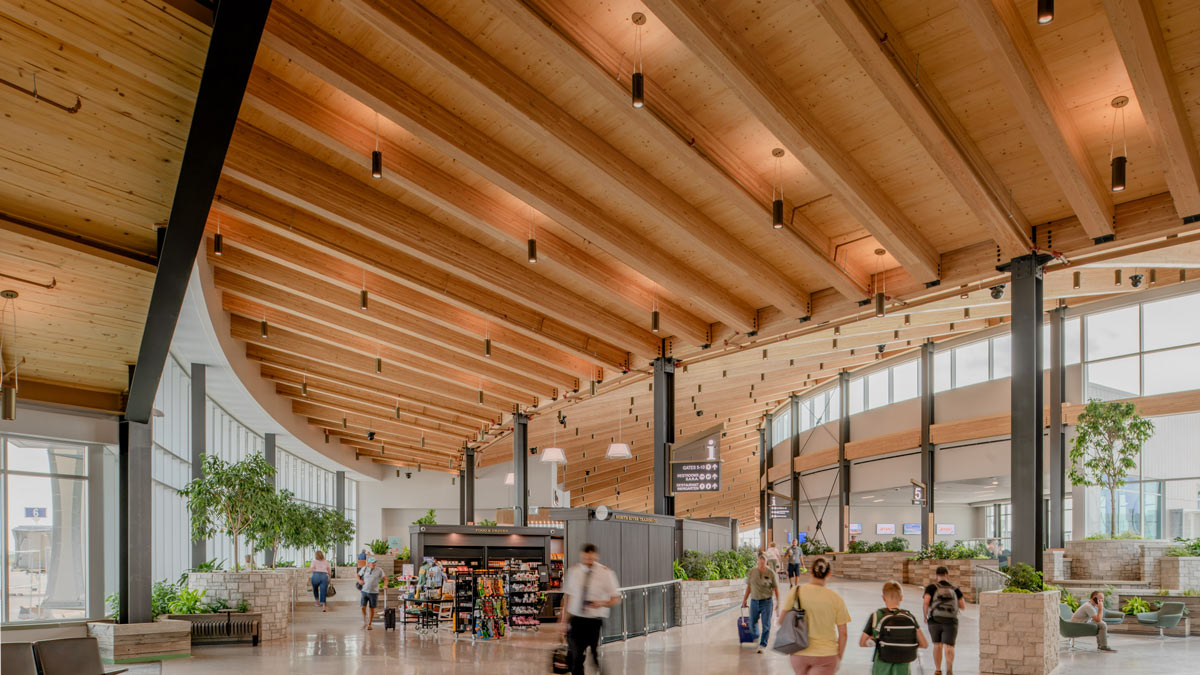
Airport featuring natural design elements of timber ceilings and interior trees

After reading my co-author Josh’s posts in this blog series on mass timber, you might think this third blog is the part where the architect starts discussing form, aesthetic, and materiality.

I might be tempted…but what resonates with me most about mass timber isn’t the material on its own. It’s what the material can do for our clients and the passenger experience.

As an architect, I prioritize user experience in my design approach. In airports especially, we design for people in transition. And with all transition comes stress. There’s the noise of announcements and rolling luggage. The pressure of making connections on time. The challenge of wayfinding. The crowds. The doubts and questions (Am I in the right lane? To check or not to check my bag?). The unsettled, anxious feeling of being somewhere in between that’s neither your starting point nor your destination.

A human-centered airport recognizes all of that with thoughtful design.

Our clients often share a similar vision: to enhance the passenger experience by reflecting the communities they serve and stewarding a more sustainable future. The use of wood as a building material helps design teams bring this vision to reality.

Human-Centered Material

In the first two blogs, Josh talked about the warmth and authenticity that exposed timber brings to a space, and I agree. There’s something about wood that feels familiar. We don’t always notice it consciously, but we respond to it on a deeper level.
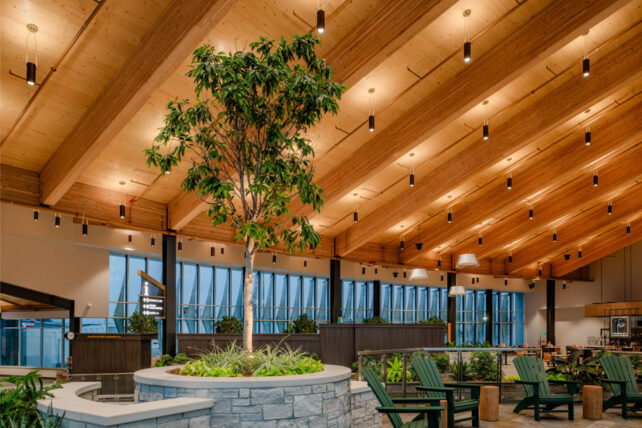
Airport featuring natural design elements of timber ceilings and interior trees
Incorporating natural elements like timber and trees helps airports deliver an excellent passenger experience while being a good steward of sustainable design.

Trees are congruous to our human experience. Consider the relationship indigenous cultures share with the forest: a reciprocal relationship between humans and the trees that has extended for millennia to support all living things through shelter, medicine, and a physical connection between the land and the spirit world.

Or the Japanese tradition of Shinrin-yoku. Forest bathing. Communing with the trees to absorb the phytoncides they release has been scientifically proven to boost immune function, regulate blood pressure, and reduce stress.

In the colonies, America’s bountiful forests were leveraged to build most structures, some we still occupy today. Our response to regional materials impacts our well-being as we tap into generational memory of wood as shelter and haven, helping occupants feel calmer, more grounded, and welcome. It’s why many of us find peace in a cabin in the woods.

Now imagine that feeling when you arrive at the airport headed to… wait – where was I going again?

Exactly.

Value Beyond Ambiance

Of course, wood isn’t just an architectural finish. It’s a structural system. And airports are incredibly complex buildings. Above every ceiling is a network of mechanical, electrical, technological, and life-safety systems working together to create a safe and functional passenger experience. The reality is some timber elements inevitably disappear behind those systems.

This begs the question: if people can’t always see the timber, is it still worth it?

I say the answer is yes.

Clients like to save where they can, of course. On projects where exposed timber isn’t possible, we’ve found cost impacts can be relatively small. Additionally, timber can offer advantages in construction sequencing and significant reductions in embodied carbon.

On a recent project, choosing mass timber reduced embodied carbon by approximately 180 metric tons of CO₂e—about an 11 percent reduction compared to a steel-framed alternative. That’s the equivalent of removing roughly 39 passenger vehicles from the road for a year or avoiding the annual electricity use of about 22 homes.

Those benefits matter whether the structure is visible or not.

More than Materiality

The biggest lesson to be learned from mass timber has very little to do with timber. It’s the collaboration.

As Josh discussed in his previous article, mass timber projects work best when architects, engineers, owners, and builders are engaged early and often. Because structure and architecture are so intertwined, everyone should have a seat at the table from the beginning. The conversations become richer, the solutions become more thoughtful, and the result is stronger because of this collaboration.

And really, that’s not a lesson that should be limited to mass timber projects.

Working with Josh, I’ve come to appreciate one of our greatest strengths is our ability to bring the architect and structural perspectives together from day one. When we align around a shared vision, we’re able to create buildings that aren’t just efficient or sustainable—they feel right.

Mass timber simply makes that collaboration easier to see.

In the end, the goal isn’t to celebrate a building material. We’re creating spaces that support people, reflect the values of their communities, and leave travelers feeling just a little less stressed than when they arrived.


headshot of rachel usher

Rachel Usher, AIA, LEED AP

Rachel Usher, AIA, LEED AP, is an architect at Mead & Hunt with more than 20 years of experience designing spaces that balance function, sustainability, and human experience. Her work spans aviation, higher education, justice, and civic projects, where she translates client goals into successful built environments. Rachel is passionate in how design decisions —materials, systems, and spatial organization — shape the way people feel and move through complex spaces.

Linkedin Envelope Readme
PrevPrevious

Most Popular

From Popsicle Stands to the Boardroom Table: My Employee Ownership Journey
October 7, 2026
The Real Value of Employee Ownership
October 1, 2026
Uncovering Nevada’s Latino Heritage: A Statewide Effort to Preserve History
September 29, 2026
Q&A with Sergio Rodriguez: Celebrating Hispanic Heritage Month
September 23, 2026

Main Menu

  • Home
  • Markets
  • Services
  • Portfolio
  • News
  • About
  • Careers
  • Home
  • Markets
  • Services
  • Portfolio
  • News
  • About
  • Careers

Useful Links

  • Ebids
  • Corporate Responsibility
  • Equipment & Parts
  • Government Contract Vehicles
  • GSA Schedules Program
  • Policy for Third-Party Recruiters
  • Transparency in Coverage
  • Ebids
  • Corporate Responsibility
  • Equipment & Parts
  • Government Contract Vehicles
  • GSA Schedules Program
  • Policy for Third-Party Recruiters
  • Transparency in Coverage

Get in touch

  • Apply Today
  • Contact Us
  • Locations
  • Title VI
  • Apply Today
  • Contact Us
  • Locations
  • Title VI

Connect with us

Linkedin Facebook Instagram Vimeo

© 2026 Mead & Hunt, Inc. All rights reserved.

Privacy Settings | Privacy & CCPA Policy | Do Not Sell | Site Map