

Skip to content
Mead & Hunt logo
  • Markets
    • Aviation
    • Cultural Resources
    • Education
    • Federal
    • Food & Beverage
    • Justice
    • Renewable Energy
    • State & Local
    • Transportation
    • Water
  • Services
    • Architecture & Interiors
    • Commissioning
    • Construction Services
    • Engineering
    • Environmental
    • Fabrication & Custom Manufacturing
    • Planning
    • Sustainability & Resilience
    • Technology & Security
  • Portfolio
  • News
  • About
    • Purpose & Values
    • Meet Our Team
    • Inclusion & Belonging
    • Corporate Responsibility
    • Locations
    • Scholarship Opportunities
    • Our History
    • Mead & Hunt Foundation
  • Careers

What a Road Project Revealed: The Story of Ames Freedom Colony

  • November 18, 2026
a stylized postcard says Greetings fom Liberty County with the Interstate 90 sign

In 2023, the Texas Department of Transportation (TxDOT) began planning improvements to US 90, the highway that threads through the heart of the Ames community in Liberty County, Texas. The agency turned to Mead & Hunt’s Cultural Resources team to survey the corridor and identify historic places the project might impact.

Their work soon revealed a much bigger story.

The team found a thriving Texas freedom colony, a place where Black families came after the Civil War in search of land and built a community generations would continue to call home. More than a century later, many of the homes and businesses they created were still there, carrying pieces of that history into the present.

The road through present-day Ames was about to lead the team deep into its past.

1890s | A Journey Takes an Unexpected Turn

The story of Ames begins with a journey that went a little off track.

In the 1890s, a group of Black Creole families left New Iberia, Louisiana, in search of land in Mexico. Disappointed by what they found, they headed back home. At a railroad station in Liberty, TX a man they met told them about land east of town selling for just $3.75 an acre. It was the opportunity they had been searching for.
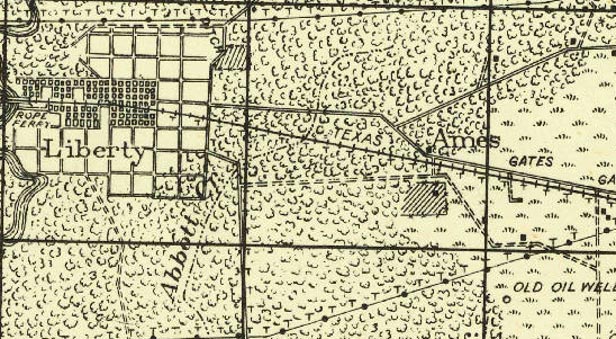
Historic survey map showing Ames east of Liberty, Texas, with the Texas and New Orleans Railroad line, roads and surrounding wooded areas.
Figure 1. 1943 map from a 1911 U.S. Army Corps of Engineers survey showing Ames in relation to the county seat of Liberty and north of the Texas and New Orleans Railroad line, along what is now Beaumont Road/Donatto Drive. Source: US Army Corps of Engineers, “Tactical Map, Texas, Liberty Quadrangle,” 1911, 1943, Perry-Castaneda Library at the University of Texas at Austin.

1910s–1920s | Putting Down Roots

As families put down roots in Ames, they began creating the places that would bring community life together. Their shared Catholic faith became part of the community’s foundation.
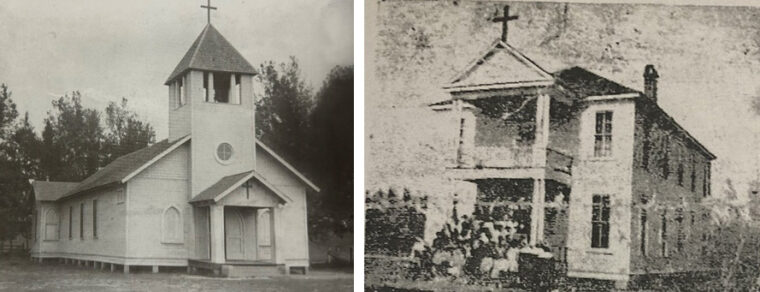
Two historic photographs showing Ames’s early Catholic church, a white wooden building with a bell tower and cross, and the community’s first Catholic school, a two-story building with a group gathered outside.
Figure 2. Ames’s second Catholic church, c.1920, and the first Catholic school, c.1917. “The Josephites and the African American Community, 100 Years, Partners in Sharing the Faith” (The Society of St. Joseph of the Sacred Heart, 2001), Private collection of Cleveland Walters, Jr. “Our Mother of Mercy School, Ames, Texas – Golden Jubilee, 1914-1964,” November 8, 1964, Private collection of Cleveland Walters, Jr.

Residents built a Catholic church themselves and dedicated it in 1897. In 1914, the parish built a two-story school that initially served 60 students. By 1929, a larger church stood in the community under the name Our Mother of Mercy Catholic Church.
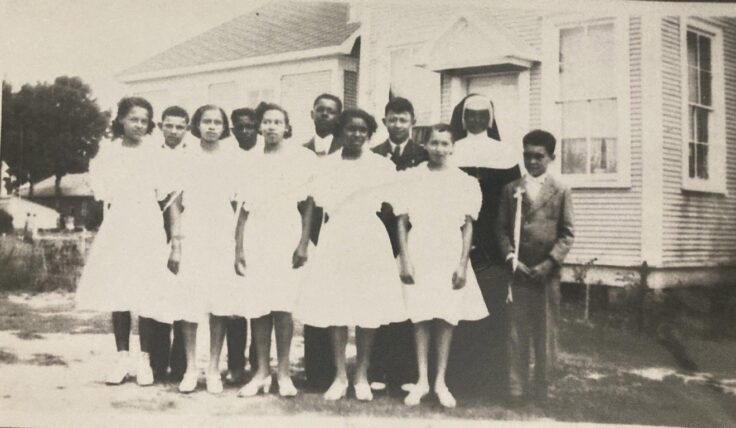
Historic photograph of the Our Mother of Mercy School graduating class, with students and a nun gathered outside the wooden school building in Ames.
Figure 3. Our Mother of Mercy School graduating class, undated. Source: Private collection of Cleveland Walters, Jr.

The school continued to educate local children for decades before closing after Liberty County schools integrated in 1966.

The graduating class photo reflects how families who came to Ames searching for opportunity began creating a future their children could inherit.

1940s–1950s | Finding a Way Forward Together

As Ames grew, its residents found ways to help one another make a living from the land.

During World War II, local farmers supplied vegetables to the Del-Dixi canning company in Orange. Then, in 1945, 156 farmers formed the Ames Produce Cooperative Service. Together, they purchased a truck that made five trips each week to Houston, where their produce and livestock could bring substantially higher prices.
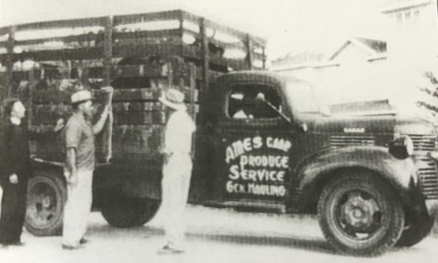
Historic photograph of the Ames Co-op produce truck parked in front of the Catholic church, with several people standing beside the truck and “Ames Co-op Produce Service” painted on the door.
Figure 4. Undated image of the Ames Co-op truck in front of the Catholic church

A truck may seem like an ordinary thing to preserve in a photograph. For Ames, it represented greater opportunity for families who made their living from what they could raise and harvest.

Another photograph takes us even closer to the heart of Ames.

In 1954, Sylvester Wickliff celebrated his 97th birthday surrounded by all but one of his children. Nearly 60 years had passed since he helped establish the community.
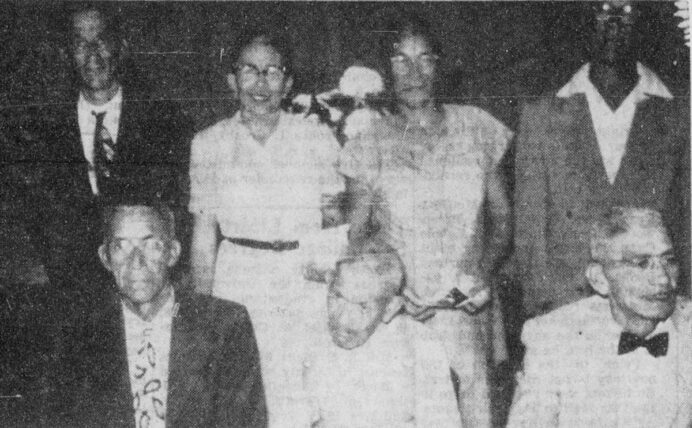
1954 newspaper photograph from the Liberty Vindicator showing seven people posed together at Ames’ founder Sylvester Wickliff’s 97th birthday celebration, with the celebrant seated at bottom center.
Figure 5. Ames founder Sylvester Wickliff, bottom center, with all but one of his children in 1954 at his 97th birthday celebration. Source: The Liberty Vindicator, September 2, 1954.

An Ames founder who once took a chance on land he learned about at a railroad station could now look around and see everything that had grown from his decision.

1950s–1970s | The Sounds and Places of Home

By midcentury, US 90 carried travelers through a community with a character all its own.

Music played a big part in laying the soundtrack of that character.

Local venues became stops on the Chitlin’ Circuit, an informal network of establishments for Black musicians to perform during segregation. Ames welcomed artists who would become household names, including Muddy Waters, B.B. King and James Brown. The Social Club was known locally for its music and gatherings.
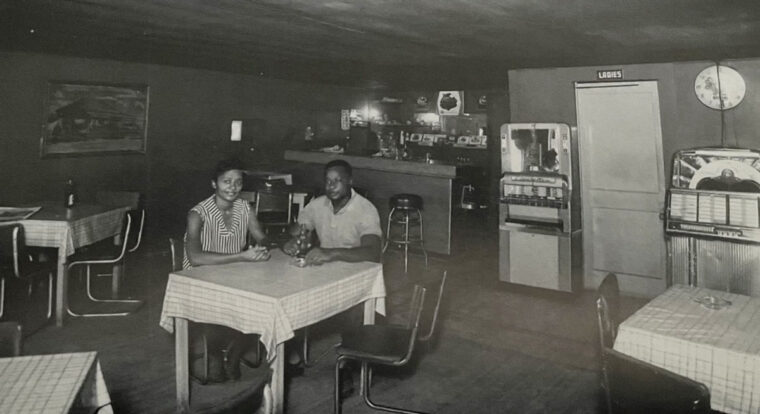
Black-and-white photograph of the Social Club interior in 1956, showing a couple sitting together at a table, with café tables, a counter, jukebox and music equipment filling the room.
Figure 6. The Social Club, “known for its atmosphere, fine music, ice cold beer, delicious food and barbecue.” Pictured are owner T. Young and Levira Mark Pickett in 1956. Photo courtesy of the private collection of Ames resident Cleveland Walters, Jr.

In 1957, Edward Wickliff, son of founder Sylvester Wickliff, opened a Gulf service station along US 90. The business survives today as Wickliff’s Gas & Grocery, still owned by the family.
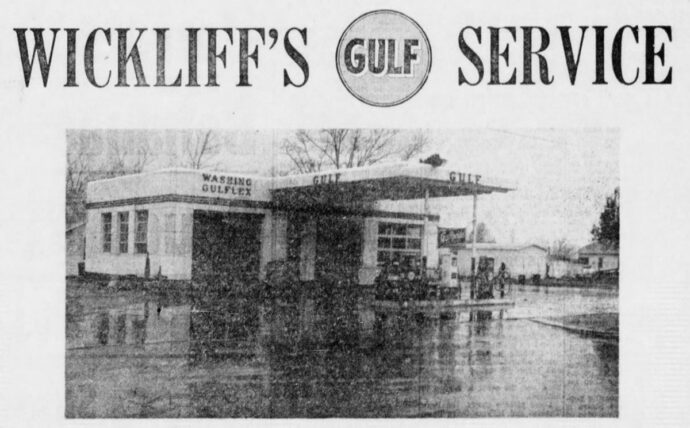
Black-and-white 1957 advertisement reading “Wickliff’s Gulf Service,” with a photograph of the service station, Gulf-branded canopy and gas pumps on a wet roadway.
Figure 7. 1957 grand opening advertisement for what is now known as Wickliff’s Gas & Grocery

The photographs let us imagine Ames the way the residents experienced it. Music drifted from a club along the highway as someone pulled into Wickliff’s for gas. Around them, neighbors waved to one another as they came and went.

History happens in the ordinary, everyday moments, too.

2023 | Listening to the Past Before Moving Forward

Decades later, the planned improvements to US 90 brought Mead & Hunt into many of those same places.

Our Cultural Resources team studied historic properties and dug into archival records. Just as important, they made it a point to listen.

Oral history interviews gave residents an opportunity to share knowledge passed down through families. In one interview, our team spoke to a 100-year-old granddaughter of a founder, only one generation removed from the founding of Ames.

Her memories and those of other residents added something documents alone could never provide.

One place where past and present meet is the Ames Fix-It Shop. In 1972, local blacksmith James Goudeau was photographed there beside the tools of his trade. He repaired farm equipment and operated a corn mill from the building.
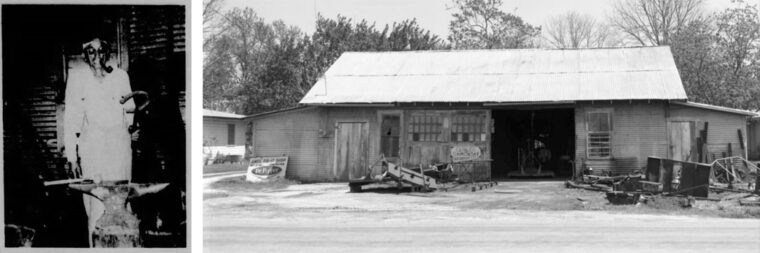
1972 black-and-white newspaper photograph showing a blacksmith standing inside the Ames Fix-It Shop behind a large anvil, with tools and the shop interior visible in the background. 1979 black-and-white photograph of the Ames Fix-It Shop, a long wood-sided building with a corrugated metal roof, open central bay and work equipment scattered outside.
Figure 8. Blacksmith James Goudeau pictured in the Ames Fix-It Shop in 1972 with his anvil on the left. Source: The Liberty Vindicator, August 31, 1972. Figure 9. The Ames Fix-It Shop in 1979, advertising welding and saw filing. Building is individually eligible for the National Register of Historic Places, along with contributing to the Ames Freedom Colony Historic District. Source: The Portal to Texas History, April 1979.

More than 50 years later, the building remains.

The team found another connection at Wickliff’s Gas & Grocery. TxDOT’s project plans were changed to avoid impacting the historic building and its canopy.
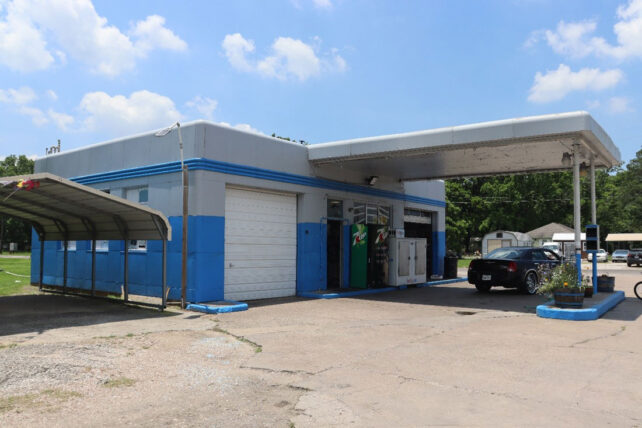
1.2023 photograph of Wickliff’s Gas & Grocery, a blue-and-white roadside building with a large gas station canopy extending over the pumps, a covered area beside the building and a vehicle at the pumps.
Figure 10. Wickliff’s Gas & Grocery in 2023.

It’s a small detail with a much larger meaning. Once you understand the story of a place, lines on a plan take on a different weight.

Today | Still Leaving Its Mark

The discoveries along US 90 eventually opened another opportunity for Ames.

The team’s research and oral histories helped solidify the community’s historical significance. The findings supported approval of a Texas Historical Marker that will share the story of Ames with people who travel this road in the future.

Mead & Hunt employees wanted to help see that recognition through. In 2024, the team secured a Mead & Hunt Cares grant to pay the marker application fee and purchase the marker. The Texas Historical Commission has since made it, and installation is expected after the US 90 roadwork is complete.

People often think preservation is about protecting historic places. Ames reminds us it’s also about protecting the stories and traditions that give those places meaning. Preservation begins with understanding why those places matter, and who carries their stories forward.

More than 130 years after a chance conversation at a railroad station redirected a group of families looking for land, Ames remains.

The Future | A Lasting Legacy

After the US 90 improvements are complete, a new historical marker will stand along the road that first led our team into Ames’ remarkable past. Travelers who once might’ve passed through without a second thought will have a reason to stop and take a closer look.

The marker will tell them how Ames began. Today, the community reflects residents’ triumph of determination and endurance.

Ames is still here.

More than 130 years later, its story continues to unfold.

PrevPrevious

Most Popular

Three Lessons from Airport Energy Experts
November 13, 2026
Meet the Mead & Hunt Foundation’s First Grant Recipients
November 12, 2026
The Day Once Known as Armistice Day: A (Not So Secret) History
November 11, 2026
Manatee County Landfill Project Breaks Ground and Featured in BiogasWorld Magazine
November 10, 2026

Main Menu

  • Home
  • Markets
  • Services
  • Portfolio
  • News
  • About
  • Careers
  • Home
  • Markets
  • Services
  • Portfolio
  • News
  • About
  • Careers

Useful Links

  • Ebids
  • Corporate Responsibility
  • Equipment & Parts
  • Government Contract Vehicles
  • GSA Schedules Program
  • Policy for Third-Party Recruiters
  • Transparency in Coverage
  • Ebids
  • Corporate Responsibility
  • Equipment & Parts
  • Government Contract Vehicles
  • GSA Schedules Program
  • Policy for Third-Party Recruiters
  • Transparency in Coverage

Get in touch

  • Apply Today
  • Contact Us
  • Locations
  • Title VI
  • Apply Today
  • Contact Us
  • Locations
  • Title VI

Connect with us

Linkedin Facebook Instagram Vimeo

© 2026 Mead & Hunt, Inc. All rights reserved.

Privacy Settings | Privacy & CCPA Policy | Do Not Sell | Site Map