
Skip to content
Mead & Hunt logo
  • Markets
    • Aviation
    • Cultural Resources
    • Education
    • Federal
    • Food & Beverage
    • Justice
    • Renewable Energy
    • State & Local
    • Transportation
    • Water
  • Services
    • Architecture & Interiors
    • Commissioning
    • Construction Services
    • Engineering
    • Environmental
    • Fabrication & Custom Manufacturing
    • Planning
    • Sustainability & Resilience
    • Technology & Security
  • Portfolio
  • News
  • About
    • Purpose & Values
    • Meet Our Team
    • Inclusion & Belonging
    • Corporate Responsibility
    • Locations
    • Scholarship Opportunities
    • Our History
    • Mead & Hunt Foundation
  • Careers
  • Markets
    • Aviation
    • Cultural Resources
    • Education
    • Federal
    • Food & Beverage
    • Justice
    • Renewable Energy
    • State & Local
    • Transportation
    • Water
  • Services
    • Architecture & Interiors
    • Commissioning
    • Construction Services
    • Engineering
    • Environmental
    • Fabrication & Custom Manufacturing
    • Planning
    • Sustainability & Resilience
    • Technology & Security
  • Portfolio
  • News
  • About
    • Purpose & Values
    • Meet Our Team
    • Inclusion & Belonging
    • Corporate Responsibility
    • Locations
    • Scholarship Opportunities
    • Our History
    • Mead & Hunt Foundation
  • Careers
Mead & Hunt logo
  • Markets
    • Aviation
    • Cultural Resources
    • Education
    • Federal
    • Food & Beverage
    • Justice
    • Renewable Energy
    • State & Local
    • Transportation
    • Water
  • Services
    • Architecture & Interiors
    • Commissioning
    • Construction Services
    • Engineering
    • Environmental
    • Fabrication & Custom Manufacturing
    • Planning
    • Sustainability & Resilience
    • Technology & Security
  • Portfolio
  • News
  • About
    • Purpose & Values
    • Meet Our Team
    • Inclusion & Belonging
    • Corporate Responsibility
    • Locations
    • Scholarship Opportunities
    • Our History
    • Mead & Hunt Foundation
  • Careers
  • Markets
    • Aviation
    • Cultural Resources
    • Education
    • Federal
    • Food & Beverage
    • Justice
    • Renewable Energy
    • State & Local
    • Transportation
    • Water
  • Services
    • Architecture & Interiors
    • Commissioning
    • Construction Services
    • Engineering
    • Environmental
    • Fabrication & Custom Manufacturing
    • Planning
    • Sustainability & Resilience
    • Technology & Security
  • Portfolio
  • News
  • About
    • Purpose & Values
    • Meet Our Team
    • Inclusion & Belonging
    • Corporate Responsibility
    • Locations
    • Scholarship Opportunities
    • Our History
    • Mead & Hunt Foundation
  • Careers

Now Available: Mass Timber Guide Specification Section

  • December 12, 2023
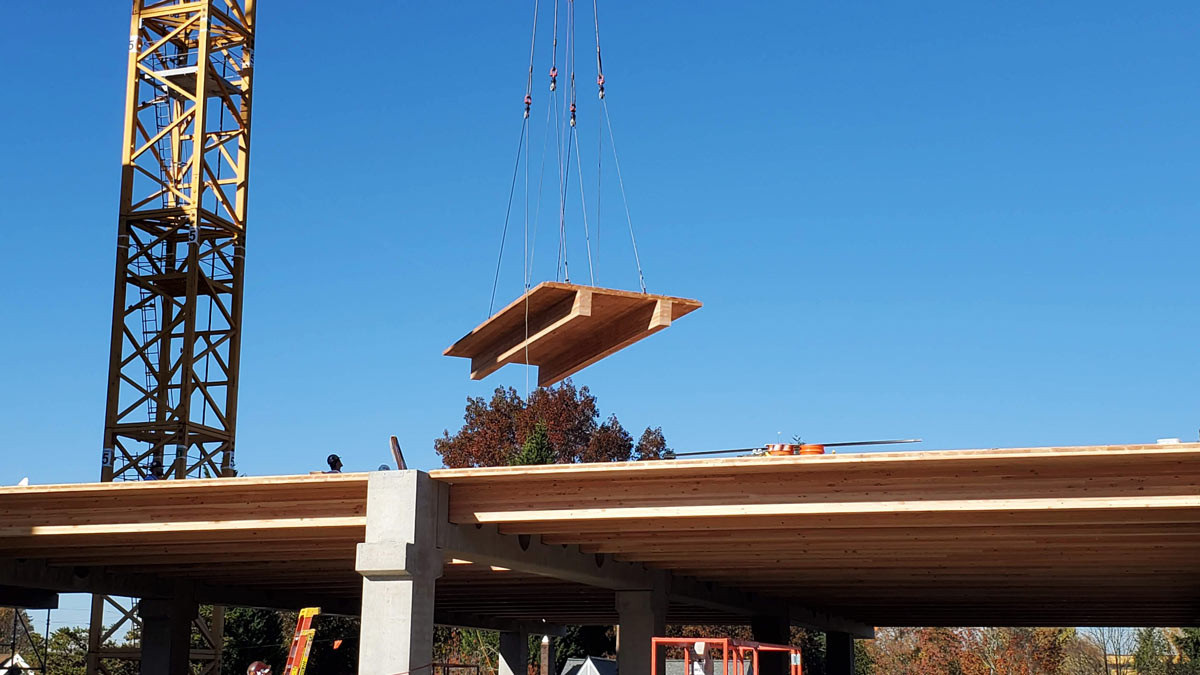
a large section of mass timber is being raised into place

(c) Image courtesy of RDH Building Science

Risks and Rewards of Mass Timber

As the design and construction industry moves toward more eco-conscious systems to construct the buildings we work and live in, mass timber has made it to the forefront of this change in direction. It is currently a favored building material for many leading architectural firms and is being strongly marketed by the wood industry.

While wood construction has never gone away, its use in large buildings was easily replaced by steel and concrete in the last two centuries. Now with its rediscovery, it is important to remember why it originally lost its place in large building construction, and more importantly, how to overcome those shortcomings to ensure a successful project.

Three reasons mass timber lost out to other materials

  1. Moisture: The wood species used in mass timber are classified as “softwood,” meaning they can both absorb and lose water. This causes mass timber to swell and shrink, often warping as it does so. Given continuous exposure to relatively small amounts of liquid water, or even high humidity, softwood will grow mold, rot, and decay. We can now counteract that condition, but only by adding chemicals to the natural product, which manufacturers of mass timber simply don’t use. Even with the addition of these products, the need to monitor and maintain moisture content extends from construction throughout the lifecycle of the building.
  2. Combustion: Wood is combustible, which means exposure to fire, if not thick enough, can completely release the wood’s sequestered carbon into the atmosphere with some residue ash. If thick enough, mass timber will only char, but will produce vast quantities of smoke which is the main cause of death in most building fires. However, the cost of repairing charred structural members may well exceed the cost to replace the building. Fire suppression/protection systems are required for most facilities. Mass timber producers currently do not use fire-treated wood. In the future, maybe we can counteract that capacity, but only by adding more chemicals to the natural product.
  3. Staining: While the exposed wood of mass timber can be beautiful in appearance, it is easily stained by construction activities, and some stains are very difficult to remove. Because of this, its installation is much more of an art than other structural materials.

Due to these and other more minor reasons, wood was basically abandoned for construction of large commercial and institutional buildings, with a preference toward steel and concrete. Once a building was fully enclosed and conditioned, wood was reintroduced as part of the building’s interior design. Even so, most of this reintroduced wood was in the form of hardwoods, and the only softwoods were primarily concealed and either pressure-treated or fire-treated to protect from its shortcomings.

The New Wood: Mass Timber’s Resurgence

As a response to climate change concerns improving availability, speed on construction, and biophilic considerations, wood in mass timber construction is being quickly reevaluated for building structures. Its implementation has moved beyond the few pioneering designers, manufacturers, and constructors, and into mainstream with much excitement and fanfare.

But is mass timber construction ready to be used by the entire design and construction industry?

While softwood is not a new structural material, its use in today’s design of mass timber buildings should be considered new. The number of designers and constructors using mass timber is quickly growing; however, very few are well experienced with the nuances of the system’s means and methods.

As we seek new ways to reduce greenhouse gases in our facility designs, it is imperative their implementation is addressed properly in construction documentation. This is a global design construction industry concern, and we need to share our knowledge to benefit everyone. This is why we are proud to release the 3-part Guide Specification, “Section 061710 – Mass Timber.”

Download the “Section 061710 – Mass Timber” and “Risks and Rewards of Mass Timber Addendum”

The 3-part Guide Specification is a collaborative effort between RDH Building Science, Jensen Hughes, and Mead & Hunt to assist in the proper implementation of mass timber construction.

• Section 061710 – Mass Timber Guide Specification »

• Risks and Rewards of Mass Timber Addendum »


Special thanks to Casey McDonald, Senior Project Engineer at RDH Building Science, and Tom Jaleski, Director at Jensen Hughes, for their contributions to this effort.


Don Koppy headshot

Donald Koppy, AIA, NCARB, CSI, CCS

As Mead & Hunt’s Master Construction Specifier, Don is a skilled professional with over four decades of experience in the architectural and construction fields. He is adept at building enduring, mutually beneficial client relationships, and is a strong leader to his team. When not at work, Don enjoys mentoring high school students in the architecture, engineering, and construction professions.

Linkedin Envelope Readme
PrevPrevious
NextNext

Most Popular

America’s 250th: A Tavern, a Revolution, and 100,000 Artifacts
July 1, 2026
New Report Explores Opportunities and Challenges of AI in Airport Security
June 24, 2026
Evaluating Ohio’s Postwar Neighborhoods: A New Framework for Preservation and Compliance
June 22, 2026
Outstanding Project Award Winner: Silver Springs State Park Boardwalks and Pedestrian Bridge
June 17, 2026

Main Menu

  • Home
  • Markets
  • Services
  • Portfolio
  • News
  • About
  • Careers
  • Home
  • Markets
  • Services
  • Portfolio
  • News
  • About
  • Careers

Useful Links

  • Ebids
  • Corporate Responsibility
  • Equipment & Parts
  • GSA Schedules Program
  • Government Contract Vehicles
  • Policy for Third-Party Recruiters
  • Transparency in Coverage
  • Ebids
  • Corporate Responsibility
  • Equipment & Parts
  • GSA Schedules Program
  • Government Contract Vehicles
  • Policy for Third-Party Recruiters
  • Transparency in Coverage

Get in touch

  • Apply Today
  • Contact Us
  • Locations
  • Title VI
  • Apply Today
  • Contact Us
  • Locations
  • Title VI

Connect with us

Linkedin Facebook Instagram Vimeo

© 2026 Mead & Hunt, Inc. All rights reserved.

Privacy Settings | Privacy & CCPA Policy | Do Not Sell | Site Map